Visit Innatefit1.com for exercise wear and equipment!!!

Your Movement Blueprint: Train Smarter by Mastering These Four Directions
Move better and get stronger efficiently. This beginner's guide explains how to train all four planes of movement—sagittal, frontal, transverse, and vertical—with actionable exercise combinations and sample workouts to build balanced, functional fitness.
SELF-HELPBEGINNERS FITNESS TIPSWORKOUTSFITNESS TIPSSTRENGTH TRAININGHEALTHY LIFESTYLE
Joseph Battle
3/6/20265 min read
Let’s address a common training oversight. Many dedicated individuals hit the gym regularly but focus on a narrow set of motions—pushing forward, squatting up and down, pulling toward the chest. This repetitive approach leaves significant potential untapped and can even set the stage for imbalance.
The solution isn’t more time spent exercising; it’s smarter training that addresses how your body is designed to move in three-dimensional space. This is the core of functional movement training.
This guide provides a beginner’s guide to training movement planes. We will deconstruct the simple concept of movement directions, often called planes, and illustrate precisely how to train all four planes of movement. This strategic approach to movement patterns training builds a more resilient, capable, and powerfully balanced physique in less time, fundamentally upgrading your fitness efficiency.
The Efficiency Problem in Modern Workouts
Most fitness routines lack dimensional awareness. People naturally gravitate toward movements they see most often or find easiest to perform, which typically happen in one or two directions. Consider the standard gym session: a bench press (forward push), a lat pulldown (vertical pull), and some leg presses (forward push with the legs). This creates a strong but one-dimensional athlete.
The consequence of this repetition is twofold. First, you develop strength in familiar patterns while neglecting the dozens of stabilizer muscles responsible for supporting those primary motions. This imbalance is a frequent source of joint discomfort and injury. Second, your results plateau because the body adapts quickly to repetitive stress.
Introducing new movement angles challenges your muscles and nervous system in fresh ways, sparking new growth and enhancing dynamic movement capacity. In essence, balanced multi-planar training delivers superior outcomes while being more time-efficient.
Demystifying Movement Planes: Your Body’s 3D Map
Think of movement planes as imaginary flat surfaces, like sheets of glass, that cut through your body. Your limbs move parallel to or across these surfaces. Visualizing them transforms abstract anatomy into a practical framework for exercise selection. There are four primary planes we target in comprehensive functional movement training.
The Sagittal Plane slices your body vertically into left and right halves. Movements in this plane go forward and backward. Everyday examples include walking, running, bicep curls, and traditional squats. The Frontal Plane also cuts vertically, but it separates your body into front and back sections.
Movements here are side-to-side, like a side shuffle, jumping jacks, or raising your arm directly out to the side. The Transverse Plane divides your body horizontally into top and bottom halves. This is the plane of rotation. Turning your head to check your blind spot, swinging a baseball bat, or throwing a punch all occur here.
Finally, the Vertical Plane involves motions directly upward against gravity or downward with control. While sometimes integrated into other planes (like a vertical jump has sagittal and vertical components), we treat it separately to ensure we build pure strength in defying gravity, a non-negotiable for total-body power.
The Sagittal Plane: Mastering Forward and Backward Motion
The sagittal plane is the most familiar territory in fitness. It governs the fundamental human movements of locomotion (going forward) and lifting objects from the ground. Training this plane builds the engine for athletic performance and daily life. However, the objective is to execute these movements with precision, not just to add weight mindlessly.
Key exercises here form the cornerstone of strength. A Bodyweight Squat trains the sagittal plane by hinging your hips back and down, then driving forward and up to stand. A Dumbbell Bench Press, where you lower the weight to your chest and press it forward and up, is another prime example.
For a pulling motion, consider the Bent-Over Row, where you pull a weight from in front of you straight back toward your torso. Mastery in the sagittal plane provides the foundational strength from which all other dynamic movement flourishes.
The Frontal Plane: Building Lateral Strength and Stability
If the sagittal plane is your highway, the frontal plane comprises the side streets and stabilizers. It is criminally under-trained, leading to weak hips, unstable knees, and poor posture. Strengthening this plane fortifies your body against lateral forces and improves your ability to change direction with power and safety.
Training this plane involves embracing sideways motion. A Lateral Lunge is a perfect introduction: step directly to the side, sink your hips back and down, then push off to return to center. Another excellent tool is the Cable Side Raise.
Stand beside a cable machine, grasp the handle with the far hand, and pull it directly away from your body in a smooth, arcing motion across your torso. These movements actively strengthen the muscles responsible for pelvic and spinal stability, a critical component of intelligent movement patterns training.
The Transverse Plane: Unleashing Rotational Power
Rotation is the secret ingredient for athletic power and a healthy, mobile spine. Every action, from getting out of a car to throwing a ball, involves the transverse plane. Neglecting it creates a rigid, vulnerable body. Training for controlled rotation builds a powerful core, enhances mobility, and translates directly to real-world function and sports performance.
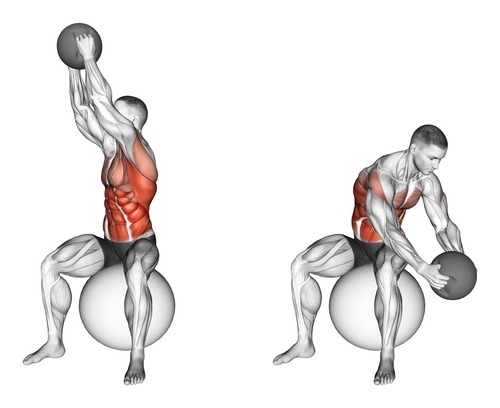
Exercises here focus on controlled, anti-rotational, and rotational force. A Pallof Press is a brilliant anti-rotation drill. Attach a cable handle at chest height, stand sideways to the machine, and press the handle straight out in front of you, resisting the cable’s pull to rotate your torso.
For active rotation, a Standing Cable Wood Chop is highly effective. With a high cable attachment, grasp the handle with both hands and pull it down and across your body in a diagonal chopping motion. This dynamic movement trains your entire core to work in synchrony.
The Vertical Plane: Conquering Gravity
The vertical plane is straightforward in concept but demanding in execution. It is all about producing and controlling force directly along the line of gravity. Strong vertical pushing and pulling muscles are essential for activities ranging from placing a suitcase in an overhead bin to climbing a rock wall. This plane ensures you can project force powerfully upward.
Vertical pressing and pulling movements define this category. A strict Overhead Press, where you drive a weight from your shoulders to a position directly above your head, is the quintessential vertical push.
Its counterpart, the Pull-Up, where you pull your entire body upward until your chin clears the bar, is the ultimate test of vertical pulling strength. Integrating these movements ensures your strength portfolio is complete and you have the capacity for true total-body functional movement training.
Crafting Your Multi-Planar Training Strategy
Understanding the planes individually is only the first step. The true advantage comes from weaving them together into a coherent strategy. The goal is to select exercises that collectively cover all four planes across your training week, ensuring no directional strength is left behind. This integrated approach is the key to training all four planes of movement.
You do not need separate workouts for each plane. Instead, design sessions that include one primary movement from two or three different planes. This method continuously educates your nervous system, engages more muscle fibers, and builds the kind of adaptable fitness that prevents injury.
For instance, pair a sagittal plane squat with a frontal plane lateral lunge and a transverse plane Pallof press. This combination builds comprehensive lower-body and core strength in a single, efficient block.
Sample Workout Combinations
Here are two realistic routines that efficiently incorporate all four planes.
Full-Body Session A (Estimated time: 45-50 mins)
Sagittal & Vertical: Goblet Squat (3 sets of 8-10 reps)
Frontal: Lateral Band Walks (3 sets of 10 steps per side)
Vertical & Sagittal: Dumbbell Overhead Press (3 sets of 8-10 reps)
Transverse: Standing Cable Rotations (3 sets of 12 per side)
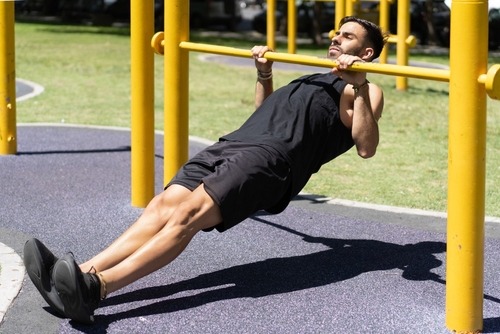
Sagittal: Inverted Bodyweight Row (3 sets to near-fatigue)
Full-Body Session B (Estimated time: 45-50 mins)
Sagittal: Hip Thrust (3 sets of 10-12 reps)
Frontal: Dumbbell Side Lunge (3 sets of 8 per side)
Vertical: Assisted Pull-Up or Lat Pulldown (3 sets of 8-10 reps)
Transverse: Pallof Press Hold (3 sets of 20-second holds per side)
Sagittal: Push-Up (3 sets to near-fatigue)
Perform these two sessions, with at least a day of rest between them, for a balanced weekly routine that systematically trains your body in every direction it is designed to move.