Visit Innatefit1.com for exercise wear and equipment!!!

Why Light Weight Wins When Gains Stall
Discover why lighter cable flies with flawless form surpass heavy weights for chest hypertrophy. Master biomechanics, execution, and programming to break through your chest plateau and maximize pectoral growth.
SELF-HELPBEGINNERS FITNESS TIPSWORKOUTSMINDSETCHEST TRAINING DEVELOPMENTFITNESS TIPSHYPERTROPHYSTRENGTH TRAININGMEN'S HEALTHEQUIPMENT SUGGESTIONS
Joseph Battle
7/16/202611 min read


Introduction: The Plateau Nobody Talks About
You have been grinding at the bench press for months. Your numbers keep climbing—you passed hitting bodyweight for singles, maybe pushing toward 1.25x on good days. Yet when you catch your reflection mid-set, your chest does not match the effort you are putting in. The stall is real. The frustration is real. And here’s the uncomfortable truth: you are probably not lifting heavy enough in the right way.
This isn’t another article telling you to abandon heavy compound lifts. Instead, this is about recognizing a critical blind spot in most intermediate lifters’ training: isolation work forms the foundation of chest hypertrophy, but only when technique demands your full attention. The cable fly variations you have been rushing through—the ones where you load weight like it’s going out of style—might actually be stealing your gains rather than building them.
The solution isn’t more weight. It is using better form. And the science of muscle growth explains exactly why.
The Physics Problem: Why Heavier Isn’t Always Better for Isolation Work
Here’s where most lifters go wrong: they apply compound lift logic to isolation movements. With the barbell bench press, adding 10 pounds often translates directly into greater stimulus because your entire body—legs, back, core—works together to stabilize the load. The movement pattern remains intact. But isolation work operates under different biomechanical rules.
When you perform a cable fly with too much weight, your body initiates a compensation cascade. Your shoulders roll forward. Your elbows bend more sharply. Your torso rotates. In essence, you are transforming an isolation exercise into a modified pressing movement, and now your anterior deltoids and triceps are hijacking the tension meant for your pecs. This is not an accidental weakness—your nervous system is being smart. It’s taking the path of least resistance.
Chest hypertrophy demands that tension remain localized to the pectoral muscles for an extended period. A load that’s too heavy accelerates the movement, reduces time under tension, and distributes force across too many muscle groups. Conversely, lighter weight allows you to control every degree of the motion, maintain constant tension throughout the range, and keep neuromuscular focus exactly where it belongs: the chest.
The pectoralis major has two distinct regions—the sternal (lower) head and the clavicular (upper) head. Both respond differently to angle and loading strategy. Isolation work, specifically cable fly variations, allows you to target these regions with precision that compound movements simply cannot match. But that precision only materializes when form is pristine.
Decoding Angles: How Joint Position Determines Pectoral Activation
Your shoulder joint is a ball-and-socket. This mobility comes with a trade-off: stability must be earned through intentional positioning. During cable fly work, the angle of your arms relative to your torso determines which muscle fibers contribute most to the movement.
Consider the basic geometry: when your elbows are at roughly 90 degrees of abduction from your torso (arms spread wide, creating a “T” shape with your body), maximum tension is concentrated on the sternal head of the pectoralis major.
This is the larger, thicker portion of the chest muscle. When the elbows angle slightly forward and closer to your midline, emphasis shifts toward the clavicular head and upper chest region. Neither angle is wrong—both are valuable. But you must understand which angle you are creating, why it changes, and how it changes based on your body position.
Many lifters unconsciously adjust their elbow angle mid-set as fatigue accumulates. The arms creep closer to the body. The elbows flex more. The movement becomes less of an arc and more of a press.
This happens because heavier weights force your body to recruit larger, stronger muscles to move the load. Lighter weight, managed properly, keeps your arms in the optimal arc longer and allows you to maintain that angle despite fatigue.
Think of your movement path like this: your elbows should trace a smooth arc from a fully open position (chest stretched) to a position where your hands nearly touch at your sternum, with your elbows remaining relatively straight throughout.
The arc is wide and deliberate. The elbow angle stays constant. This is the path that maximizes time under tension for pectoral hypertrophy while minimizing compensatory movement patterns.
The cable fly offers another advantage: adjustable angles. Changing the height of the cable attachment point shifts emphasis between the upper, middle, and lower chest. A high-to-low diagonal creates preferential activation of the lower chest.
A low-to-high diagonal targets the upper chest. Understanding these angles transforms cable work from a generic “chest exercise” into a strategic tool for building balanced development.
Cable Fly Execution: The Step-by-Step Blueprint for Perfect Form
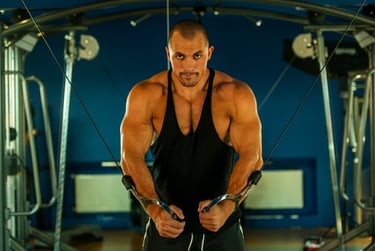
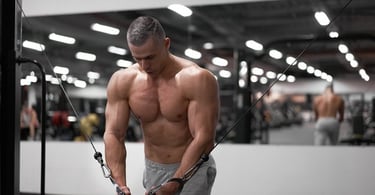
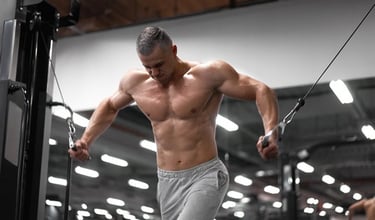
Begin by setting the cable pulleys at shoulder height. Stand in the center, slightly forward of the center point where cables intersect. This position is crucial: if you stand directly in the middle, cables pull straight ahead. By stepping forward slightly, you create a slight inward angle that amplifies pectoral contraction at the end range.
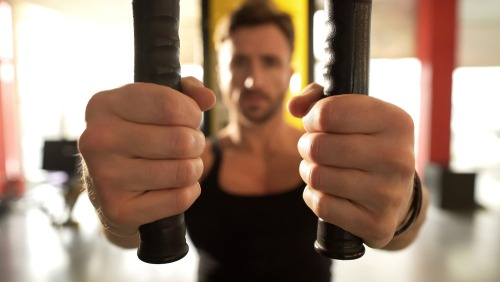
Grip the handles with a neutral wrist position—as if shaking hands. Many lifters rotate their wrists excessively, turning palms upward. This subtle change recruits biceps and reduces chest isolation. Keep your wrist locked in a neutral position throughout all repetitions. Your arms should feel like extensions of the cables, not independent levers.
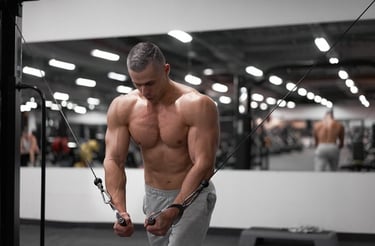
Establish a stable stance: feet shoulder-width apart, one foot slightly forward if needed for balance, knees maintaining a slight bend. Your torso remains upright—vertical—throughout the movement. This is non-negotiable. Any forward lean transforms the exercise into a blend of pressing and flying, diluting the isolation benefit. Your core must brace to prevent any rotation or excessive forward movement.
Now initiate the movement: press your shoulders down and back slightly. This subtle positioning keeps your chest “proud” and upper back engaged. From here, allow your arms to open in a wide arc, moving away from the midline of your body. Imagine spreading your arms outward and slightly backward, as if you’re hugging a large barrel. Your chest stretches maximally at this position—you should feel a deep stretch across your pectorals and anterior shoulders.
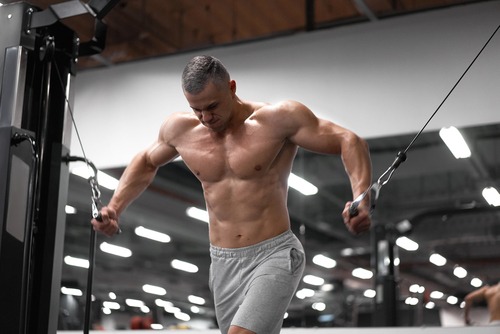
From this stretched position, drive the movement by contracting your chest (not by driving your elbows forward). The contraction initiates the movement back toward the center. Your hands approach each other in a smooth arc, arriving at a position where your hands are near your sternum but not touching. The movement is controlled throughout—both the opening and closing phases demand muscular control. This isn’t about speed. But about your intention. What do you want more?
Once hands reach the closest point, pause briefly—one second at most—and feel the pectoral contraction intensify. Then, with controlled tempo, allow the cables to pull your arms back out to the starting position.
The eccentric (lengthening) phase should move slightly slower than the concentric phase, roughly 2-3 seconds compared to 1-2 seconds. This tempo structure—controlled concentrics with slightly slower eccentrics—maximizes mind-muscle connection chest workout potential.
The Form Faults That Kill Your Gains
Understanding correct form means understanding what destroys it. Several compensatory patterns appear frequently, and each one reduces pectoral activation while increasing joint stress.
The Elbows-In Collapse occurs when lifters allow their elbows to bend excessively during the movement. Rather than maintaining a relatively straight arm position (with a slight, natural bend at the elbow), they crease more and more as fatigue accumulates. This transforms the cable fly into something that approximates a cable press, with the triceps and anterior deltoids dominating the movement pattern.
The pecs are relegated to secondary muscle status. To counter this, use a lighter weight, focus on “pushing” your elbows wide rather than bringing them toward your body, and stop sets at the point where you can no longer maintain the arm position.
Anterior Deltoid Dominance represents another critical concern. Many lifters unconsciously shrug their shoulders slightly during flies, bringing their shoulders toward their ears. This shifts the line of pull, forcing deltoids to contribute more heavily to the movement.
The solution involves deliberately depressing your shoulders—pressing them down and back—at the start of each set. This positioning activates your lower trapezius and keeps your pectorals in the prime position to handle the load. When your shoulders are shrugged, your deltoids become competitors for the tension meant for your chest.
Range-of-Motion Reduction happens gradually, usually without conscious awareness. Lifters begin with full, wide arm positions but progressively reduce the width of the arc as sets progress. This reduces the stretch stimulus—one of the three primary drivers of hypertrophy—and limits the distance over which tension is applied.
Over the course of a full training session, this reduction in range significantly diminishes the growth stimulus. Maintaining full range requires lighter loading, which brings us back to the fundamental principle: lighter weight enables better form, which produces better results.
Loss of Vertical Torso Position deserves specific attention because it’s so common. Many lifters unconsciously lean forward during the closing phase of the movement. This anterior torso lean shifts emphasis toward the anterior deltoids and reduces pectoral involvement.
Staying vertical requires a strong core brace and appropriate load selection. Heavy weight encourages forward lean because it increases the demand on your entire anterior chain. Lighter weight allows you to remain vertical and focused.
Programming for Progress: Sets, Reps, Tempo, and Recovery
Cable fly work doesn’t require the same progressive overload philosophy as compound lifts. You will not be adding five pounds every week. Instead, progress manifests through improved form quality, increased volume at stable weights, and refined mind-muscle connection.
For intermediate lifters addressing a chest plateau, cable fly variations work best as secondary movements performed after compound pressing. Two to three sets of 10 to 15 repetitions per session serve most trainees well.
The rep range matters: this window allows sufficient time under tension (target 40-60 seconds per set) without requiring excessively heavy loading. Repetitions in this range also facilitate the motor control necessary to maintain pristine form across all reps.
Tempo becomes your primary progression tool. Begin with a 2-1-2 tempo (two seconds lowering, one second pause, two seconds closing phase). Once you start mastering this tempo and feel solid pectoral contraction throughout, progress to a 3-1-2 tempo.
The extended eccentric phase (lowering) increases mechanical tension and metabolic stress—two critical drivers of hypertrophy. Never progress the tempo before the form is bulletproof, as rushing this transition typically creates compensatory patterns.
Rest periods between sets should span 60-90 seconds. This allows sufficient recovery for your nervous system to execute another quality set while maintaining cardiovascular challenge and metabolic work. Longer rest periods are unnecessary for isolation work and may lead to excessive tension loss.
Frequency matters as well. Cable fly variations can be performed twice per week, with at least 72 hours between sessions. This frequency allows adequate volume accumulation while respecting recovery needs.
One session might use a neutral or slightly low-to-high angle (emphasizing the lower chest), while the second session uses a low-to-high angle (emphasizing the upper chest). This approach ensures balanced development and systematically addresses both pectoral regions.
Avoiding anterior deltoid dominance during programming means strategic exercise selection. Perform cable flies as secondary movements after compound pressing when you are fresh enough to prioritize mind-muscle connection. If performed late in the workout in a fatigued state, your chest becomes secondary, and your shoulders take priority.
Additionally, ensure your weekly program does not overemphasize anterior deltoid work through excessive pressing volume. Balance pressing with rowing and other horizontal pulling to maintain shoulder health and prevent compensatory patterns.
The Neuromuscular Advantage: Why Your Brain Controls Your Gains
Here’s a fact that separates advanced trainees from intermediates: muscular growth depends as much on nervous system recruitment as it does on mechanical load. Your nervous system must be able to consistently recruit and fire pectoral muscle fibers with intensity. A load that’s too heavy prevents this because it forces your body to recruit stabilizer muscles and larger, more powerful muscle groups instead.
Lighter weight, executed with perfect form, teaches your nervous system to recognize and preferentially activate pectoral muscle fibers. This process is called “neuromuscular adaptation,” and it’s foundational to hypertrophy.
The more effectively your nervous system can isolate and activate a target muscle, the greater the tension you can apply to those fibers, and consequently, the greater the growth stimulus.
This is why mind-muscle connection chest workout philosophy is not some mystical or bro-science—it’s applied neuroscience. When you focus intently on feeling your chest work with each repetition, you begin to literally optimize neural recruitment patterns. You’re training your nervous system to preferentially activate pectoral fibers rather than allowing shoulders and triceps to dominate.
The cable fly, when executed properly with lightweight, becomes a teaching tool. It trains your body to feel tension and to isolate a specific muscle group. These skills transfer. Your bench press improves because you understand pectoral activation better. Your push-ups improve. Your pressing strength and mass gains accelerate because you have built a more sophisticated neuromuscular connection with your chest.
Integration Into Your Complete Chest Protocol
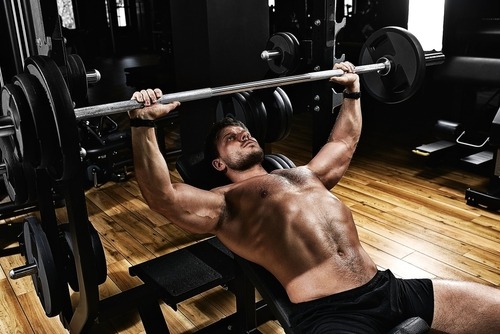
Effective chest development requires a complete approach. Compound pressing movements—barbell bench, dumbbell press, incline press—build total mass and strength. Cable fly variations and other isolation work refine that mass into defined, symmetrical muscle bellies. They address imbalances and ensure all pectoral regions receive adequate stimulus.
After addressing your technique with cable flyes, you will more than likely notice improvements in your chest that cascade into your other lifts. Your bench press form will feel cleaner. Your strength gains may accelerate. This isn’t a coincidence—it’s the nervous system benefit of improved motor control and muscle recruitment.
The psychological component matters too. When you transition from heavy cable flies with sloppy form to lighter cable flies with pristine form, the weight feels lighter. Your ego might resist this.
Every lifter experiences this. But results speak louder than loaded bars. Within four to six weeks of prioritizing form over weight on isolation work, your chest size will increase noticeably, and your compound lift performance will improve.
The path forward is clear: reduce the cable’s flyweight by 20-30 percent from what you are currently using. Spend one full workout session—maybe 10-15 minutes—just learning the movement with this lighter weight.
Feel your chest work. Develop that mind-muscle connection. Then, over subsequent sessions, progress tempo and volume while maintaining this reduced weight. Your chest gains will follow.
FAQ: Your Cable Fly Questions Answered
Q: How much weight reduction should I expect when switching to proper form?
A: Most lifters find that proper form requires 20-30 percent less weight than their current loads. If you have been using 40 pounds per side, expect proper form to feel good with 28-32 pounds.
This is not considered failure—it’s calibration. Your muscles don’t care about the weight; they care about tension and control. Lighter weight with perfect form creates more useful tension than heavy weight with broken form.
Q: Can I progress the cable fly weight consistently?
A: Progression on cable flies differs from compound lifts. Instead of adding five pounds weekly, progression happens through tempo increases, range refinement, and volume addition.
You might add one or two reps per set every 2-3 weeks, or you might increase tempo every 4-6 weeks. Weight progression happens more slowly—perhaps 5 pounds per 6-8 weeks—but it’s sustainable and injury-preventative. This patience builds superior muscle quality.
Q: How do I know if my elbows are bent too much?
A: Your elbows should maintain a relatively consistent angle throughout the movement—roughly 20-30 degrees of bend. To assess this, perform the movement slowly and watch your reflection sideways (have your phone record video).
Your elbow angle at the stretch position should match the angle at the contraction position. If the angle increases during the set, your form is deteriorating. When this happens, reduce weight immediately or end the set.
Q: Should cable flies come before or after compound pressing?
A: Cable flies should follow compound pressing. Your chest is fresh after pressing, so you can load appropriately. More importantly, compound work that precedes isolation work does not require pristine isolated form—you’re recruiting all available muscles.
Isolation work demands specific focus and neuromuscular precision, making it optimal for secondary or tertiary movement status. Performing it first wastes its potential.
Q: Why does my chest fatigue less than my shoulders during cable flies?
A: This signals compensation—your anterior deltoids are hijacking tension meant for your pecs. Check three things: First, is your weight too heavy? Second, are your shoulders shrugged? Press them down deliberately.
Third, is your elbow position too close to your body? Your arms should open wider to create a greater arc. Addressing all three usually resolves shoulder dominance issues in a single session.
Q: How long until I see chest hypertrophy improvements?
A: Most trainees observe noticeably improved chest shape and size within 4-6 weeks of consistent, proper-form cable work integrated into a complete training program. The improvements come from two sources: actual muscle growth and improved neuromuscular recruitment, which makes existing muscle appear more defined.
The “pump” becomes more pronounced. The separation between pectoral regions becomes more obvious. These changes compound over weeks and months, creating substantial visual differences within 8-12 weeks.
Q: Is one cable fly variation enough, or should I rotate?
A: One or two angles work optimally for most trainees. Changing the cable height slightly between sessions (high-to-low versus low-to-high) ensures balanced development. But constantly rotating different variations prevents mastery of any single variation.
Spend 3-4 weeks with one angle, master it, then consider alternating between two angles. This approach builds competency while ensuring comprehensive chest development.
Q: Can I use cable flies as my primary chest movement?
A: No. Isolation work cannot generate the total mechanical tension or systemic strength stimulus required for optimal chest development. Compound pressing movements must remain primary.
Cable flies serve as supplementary work that refines what compound movements build. This hierarchy isn’t opinion—it’s physiology. Prioritize pressing; refine with isolation.