Visit Innatefit1.com for exercise wear and equipment!!!

From Dusty Equipment to Daily Discipline: 5 Habits That Help You Get the Most Out of Home Fitness Essentials
Discover 5 daily habits that help you get the most out of home fitness essentials. Learn how to design a functional home fitness space, improve workout consistency, and keep a home gym safe and organized for long-term training results.
SELF-HELPMINDSETWORKOUTSMEN'S HEALTHWOMEN'S HEALTHFITNESS TIPSEQUIPMENT SUGGESTIONSHEALTH
Joseph Battle
5/27/202611 min read
Introduction
Have you ever looked at a piece of equipment sitting in the corner of your room and thought, “I should really use that today”? That thought alone tells a powerful story. It means the intention is there. The investment has been made. But something between the goal and the action keeps getting in the way.
That gap is not a motivation problem. It is a systems problem. And the good news is that systems can be fixed.
Home fitness has grown into something far more serious than a temporary substitute for commercial gyms. People are building purposeful spaces, selecting thoughtful equipment, and committing to long-term training at home. But owning the right tools is only the beginning. The real question is whether those tools are being used well, consistently, and safely every single day.
This article walks through five powerful daily habits, plus one bonus habit, that help you get the most out of home fitness essentials. These habits are not complicated. They are practical, repeatable, and designed to turn your home gym from a collection of objects into a genuine training system. Affiliate Disclosure: This post contains affiliate links; I may receive a small commission if you purchase through them, at no additional cost to you.
Why Home Fitness Has Become a Serious Long-Term Solution
Home fitness is no longer a backup plan. For many people, it has become a smarter, more flexible, and more cost-effective way to train. Whether the setup includes a few resistance bands on a closet shelf or a fully equipped garage gym with racks, machines, and flooring, the potential is real. But potential only becomes results when behavior supports it.
Here is what most people get wrong. They focus heavily on the equipment and lightly on the environment. They invest in the tools but do not design the space around action. A treadmill that faces a blank wall and sits behind a pile of storage boxes will not be used as often as one that is positioned, lit, and ready to go. A set of dumbbells stored in a bin under the stairs will collect dust far faster than a rack placed where they are visible and easy to grab.
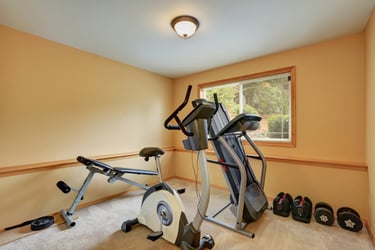
Furthermore, daily habits matter far more than the quantity of equipment owned. A thoughtful routine built around even basic fitness essentials will deliver better results than a fully stocked home gym with no organizing structure behind it. The goal of this article is to help close that gap by giving readers clear, actionable habits they can begin applying immediately. Exercise bike.
Prepare Your Workout Space Before You Actually Need It
One of the most underrated strategies in home fitness is simple preparation. Not during the workout. Not at the start of it. Before it ever begins.
Think about how much mental energy is spent when workout time arrives, and the space is not ready. Weights need to be found. The mat is rolled up across the room. The lighting is dim. There is nowhere to set a water bottle. Before a single rep is performed, the brain has already decided this feels like too much work. That friction is invisible but powerful. It shapes behavior more than most people realize.
What Daily Space Preparation Should Actually Look Like
Preparing the workout area does not require a lengthy routine. It simply means reducing every possible obstacle between the intention to train and the first movement of the session. This includes placing dumbbells, kettlebells, bands, and mats where they are easy to reach without having to search. It also means clearing walking paths and lifting zones so there is nothing to trip over or bump into during a set.
Additionally, small environmental details make a significant difference. Check that the flooring is dry and stable. Keep water and a towel within arm’s reach. Adjust lighting so the space feels energizing rather than gloomy. Remove visual distractions from the training area when possible. These steps take five to ten minutes, but they reduce the mental load of starting a workout and dramatically improve workout consistency over time.
As a design principle, home fitness essentials should be arranged based on how often they are used. Equipment that is used daily should be visible, accessible, and positioned at the center of the training space. Items used less frequently can be stored neatly but should never block movement or create clutter in the main working area.
Build a Training Schedule That Honestly Matches Your Space and Life
A schedule is one of the most powerful tools available to anyone serious about home fitness. But not all schedules are created equal. A schedule that looks impressive on paper but cannot realistically be followed is not a training plan. It is a source of guilt. Weight bench for home.
The keyword here is realistic. A home gym does not automatically create discipline. The schedule must align with the person’s actual lifestyle, the available equipment, and the body’s genuine recovery needs. When a plan is too complicated, too long, or too demanding for the equipment on hand, it creates inconsistency. And inconsistency is the single biggest obstacle to getting the most out of home fitness essentials.
How to Design a Practical Weekly Training Structure
Building a useful schedule starts with understanding the purpose rather than chasing variety. Strength days can be organized around dumbbells, barbells, kettlebells, or resistance machines. Mobility days work well with mats, bands, and bodyweight movements. Conditioning days can use jump ropes, stationary bikes, treadmills, or circuit-style training. Recovery days should be treated as active rest, including walking, light stretching, breathing exercises, or easy movement that supports the body without overtaxing it.
Moreover, a well-designed schedule also helps prevent equipment conflicts and wasted time. If the training space is shared or if multiple types of sessions happen throughout the week, the schedule should account for how the space transitions between modes. A clear structure reduces the daily decision-making that often leads to skipped sessions. Instead of asking, "What should I do today?" the schedule answers that question automatically. Consistency improves not because willpower increases, but because the routine becomes easier to repeat.
Give Every Piece of Equipment a Clear and Specific Purpose
Here is a question worth sitting with: Do you know exactly what each piece of equipment in your training space is for? Not in a vague sense, but in a specific, programmed sense tied directly to your goals?
Many people acquire home fitness essentials without a clear plan for how each item fits into their training. This leads to scattered workouts, poor progression, and the creeping sense that the equipment is not working. In reality, the equipment is fine. The missing piece is purposeful integration.
Matching Equipment to Training Goals
Every common home fitness essential has a primary role. Resistance bands are excellent for warm-ups, joint preparation, mobility work, and muscle activation before heavier training. Dumbbells support strength training, hypertrophy, and unilateral exercises that build balanced muscle development. Kettlebells bring power, conditioning, grip strength, and loaded-carry work into a compact, versatile format.
Furthermore, an exercise mat serves as the foundation for core training, stretching, floor-based strength work, and mobility sessions. An adjustable bench opens access to pressing movements, rows, step-ups, and incline and decline variations that add depth to any dumbbell or barbell routine.
Cardio machines, whether treadmills, bikes, or rowers, support heart health, conditioning, warm-ups, and active recovery sessions. Foam rollers and mobility tools play a critical role in soft tissue preparation and post-workout recovery. Heavy bands for exercise.
The best home gyms are not built around owning the most equipment. They are built around selecting the right tools for specific goals, training styles, available space, and safety requirements. When each piece of equipment has a purpose, the training space becomes organized around intention rather than impulse.
Keep the Space Clean, Safe, and Designed for Free Movement
Safety is not a weekend project. It is a daily habit. And in a home gym setting, it deserves the same attention as programming, scheduling, and nutrition.
A cluttered training space creates real risks. Loose weights on the floor, resistance bands left stretched across walkways, unstable benches, and wet or slippery flooring can all contribute to injury. More subtly, a disorganized environment also affects the quality of training. When movement is restricted by clutter, mechanics suffer. A squat performed in a tight space differs from one performed in an open, clearly defined lifting zone.
What to Check Before and After Every Training Session
Knowing how to keep a home gym safe and organized starts with building a simple pre-session and post-session checklist. Before training, verify that weights are stored properly and that the lifting zone is completely clear. Check that resistance bands have no visible tears or weak points. Confirm that benches, racks, and any machines are stable. Make sure the flooring is dry and that the surface provides adequate grip for the planned movements.
After training, return all equipment to its designated storage area. Wipe down surfaces and handles. Keep cords, straps, and accessories off the floor and out of pathways. This post-session cleanup takes only a few minutes and ensures the space is ready for the next session with no additional effort. For those designing private training spaces or working with clients at home, a clean and organized environment also communicates professionalism, care, and attention to safety. Resistance bands.
Additionally, the concept of “movement clearance” is worth understanding. Every training space should provide enough room to lunge, hinge, press, pull, jump, stretch, and carry weight without bumping into furniture, walls, or stored equipment. If the current layout does not allow for a full range of motion in key exercises, reorganizing the space is a higher priority than purchasing new equipment.
Track Progress, Equipment Usage, and Long-Term Training Value
Tracking is often discussed narrowly, usually in terms of body weight or calories. But for home fitness, a more complete approach to tracking reveals something far more valuable: whether the training system is actually working.
Progress in home fitness shows up in many forms. Strength improves. Endurance increases. Mobility expands. Recovery becomes more efficient. Energy before and after sessions shifts over time. These are all measurable markers that indicate whether the daily habits are producing meaningful results. Focusing solely on body weight overlooks most of the value consistent home training delivers.
What a Useful Home Fitness Tracking System Looks Like
A practical tracking approach should include exercises performed, weights used, reps and sets completed, workout duration, rest periods taken, and notes on how movement felt. Mobility improvements deserve their own tracking column. Recovery quality, including sleep and energy levels, is also worth recording because it directly affects training performance over time.
Equally important, and often overlooked, is tracking equipment usage. Make a note of which pieces of equipment are used most frequently and which are used least frequently. If certain tools never appear in the training log, the issue may not be the equipment itself. Poor placement, lack of programming, or misalignment with actual goals may be the real cause. Tracking usage helps identify what belongs in the training space and what needs to be relocated, replaced, or removed entirely.
Home fitness essentials should earn their space. Especially in smaller training areas where every square foot matters, each piece of equipment should have a clearly demonstrated purpose and a consistent role in the weekly training routine. Equipment that does not meet this standard occupies space that could be better used for movement, safety, or recovery.
Bonus Habit: Support Every Training Day With Recovery and Nutrition That Matches the Work
No training habit exists in isolation. The body brought into the workout space every day is either fueled, rested, and prepared, or depleted, underfed, and carrying fatigue from the previous session. Recovery and nutrition are not separate from the design of a functional home fitness space. They are built into the system.
This does not require complicated meal plans or rigid nutrition protocols. It simply requires consistency with a few foundational habits that support the physical demands of regular training. Meal plan kits.
Simple Nutrition Habits That Support Home Training
Eating enough protein is the most important nutritional habit for anyone engaged in regular strength or conditioning work. Protein supports muscle repair and adaptation, which means the training actually produces results. Staying hydrated before and after sessions is equally important, especially during warmer months or higher-intensity conditioning work.
Moreover, carbohydrate intake matters more on intense training days and less on lighter recovery days. Avoiding hard training when significantly underfed or carrying excessive fatigue is not a sign of weakness. It is a smart management of the body as a long-term training tool. Keeping simple, balanced post-workout meals available reduces friction around recovery nutrition, just as preparing the workout space reduces friction around starting a session.
Recovery Habits That Should Be Built Into Every Week
Recovery belongs inside the home fitness system, not outside it. Consistent sleep is the single most powerful recovery tool available. Light mobility work, stretching, and walking on rest days keep the body moving without adding stress. Breathwork after intense sessions helps the nervous system transition from a high-activation state back to a recovery state.
Furthermore, the home gym itself should include dedicated space and tools for cooldown work. A mat for stretching, a foam roller for soft-tissue work, and enough open floor space for breathing and mobility exercises all belong in the training space alongside the equipment used for the harder sessions. When recovery is treated as a built-in part of the routine rather than an optional add-on, training quality improves, injury risk decreases, and the entire home fitness system becomes more sustainable over the long term.
Turning Home Fitness Essentials Into a Complete Daily Training System
The value of home fitness is not measured by how much equipment fills the space. It is measured by how often the equipment is used with intention, preparation, and care. A thoughtful, habit-driven approach turns even a modest collection of fitness essentials into a reliable training system that supports strength, movement, health, and long-term consistency. Kettlebell sets.
To recap, the five daily habits that help home gym users get the most out of home fitness essentials are as follows. First, prepare the workout space before training begins to eliminate friction and make it easy to start. Second, follow a realistic training schedule that matches available equipment, personal lifestyle, and genuine recovery capacity.
Third, assign a specific role to each piece of equipment in the training plan to give each session direction and purpose. Fourth, maintain the space with daily safety checks and post-session cleanup to protect both the body and the equipment. Fifth, consistently track progress and equipment usage so the training system can be evaluated, adjusted, and improved over time.
The Bigger Picture: A Personal Training Environment That Works for Real Life
When these habits are practiced consistently, something shifts. The home gym stops feeling like an obligation and starts functioning like a genuine personal training environment. Sessions become easier to start, safer to perform, and more effective to repeat. The equipment earns its place in the space because it is being used with clarity and purpose.
Home fitness, when supported by the right daily habits, does not require a commercial gym setting to deliver serious results. It requires a well-prepared space, a realistic schedule, purposeful use of equipment, consistent safety habits, honest progress tracking, and a recovery foundation that supports the work being done. These are not extraordinary demands. They are the daily disciplines that separate a home gym that produces results from one that simply takes up room.
The invitation here is straightforward. Start with one habit. Prepare the space for tomorrow’s session tonight. Build from there. Every improvement compounds, and every small habit contributes to a home fitness routine that is organized, safe, effective, and built to last.