Visit Innatefit1.com for exercise wear and equipment!!!

Evening Workout Challenges and the Hidden Cost of Long Workdays on Your Body
Evening workout challenges often begin long before exercise starts. See how long workdays affect energy, recovery, and fitness after work.
SELF-HELPMINDSETWORKOUTSHEALTHY LIFESTYLEMEN'S HEALTHWOMEN'S HEALTHHEALTHMOTIVATION
Joseph Battle
3/27/202614 min read


Introduction
For many business owners and remote workers, the intention is there. The shoes are by the door, the workout plan is saved, and the mind says that today will be different. Then evening comes, and somehow the body feels heavier, the brain feels crowded, and exercise begins to feel like one more demand instead of a form of relief. That contradiction is frustrating. You can care about your health, respect the value of movement, and still find fitness after work far more difficult than expected.
This struggle is often misunderstood. People tend to reduce it to a motivation problem, yet that explanation is too shallow. In reality, evening workout challenges are usually the result of mental overload, physical stagnation, decision fatigue, stress accumulation, and a workday that quietly drains the body far more than most people realize. By the time work is done, many professionals are not simply “lazy” or “undisciplined.” They are mentally taxed, physically stiff, emotionally depleted, and pulled toward the fastest form of comfort they can find.
That is especially true for business owners and remote workers. One group often carries the pressure of constant responsibility. The other often works in an environment where the lines between professional time and personal time never fully separate. Both can end the day exhausted in ways that are hard to explain to others. On the surface, it may seem that sitting at a desk all day should leave plenty of energy for exercise. On the inside, however, the body tells a different story.
This article explores why evening fitness for busy professionals can feel so difficult, how mental fatigue and exercise often work against each other after a long day, and why building healthy habits for professionals requires more than simply telling yourself to try harder. Once the real causes are named clearly, the problem begins to look less like personal failure and more like a pattern that can be understood and improved.
Why Evening Workout Challenges Build Slowly Across a Long Workday
One of the most important things to recognize is that evening workout challenges rarely begin in the evening. They usually begin early in the day, then build quietly in the background hour by hour. By the time work ends, the struggle has already been developing for quite some time.
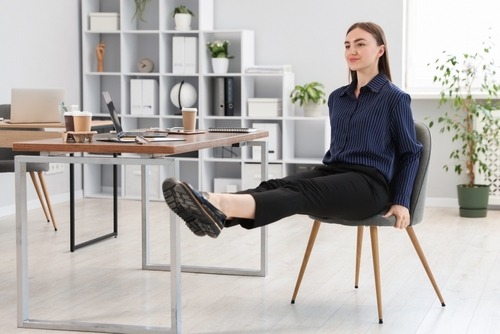
A long workday places repeated demands on attention, posture, energy, and nervous system regulation. Emails, calls, deadlines, client requests, decision-making, problem-solving, and constant digital interaction all take a toll. Even if the work is not physically demanding in the traditional sense, the body still experiences strain. Muscles remain in low-level tension. Breathing becomes shallow. The neck stiffens. The hips tighten. The eyes get tired. The brain keeps switching from one responsibility to the next, often without genuine recovery.
For remote workers, the issue can become even more subtle. When work happens at home, there is often no clear physical transition between professional effort and personal time. The same space where you answer messages may also be the space where you plan to exercise. That can make the mind feel as though work is still active, even when the laptop is closed. In that kind of environment, fitness after work can feel mentally crowded before the workout even begins.
Business owners face a related challenge, though it often looks slightly different. Their workday may not end just because the official tasks are over. There may still be concerns about finances, staffing, growth, customer communication, and unfinished priorities. Even during free time, their thoughts may remain attached to the business. In that condition, the body may technically be available to train, but the mind is still at work.
This is where many people become too hard on themselves. They assume that because they had intended to exercise, they should be able to flip a switch and perform. Yet the body does not work like a machine. It responds to the sum of the day, not just the final hour. A long workday can gradually reduce the willingness to exert effort, the ability to focus, and the desire to tolerate discomfort. That does not mean progress is impossible. It simply means the evening workout is affected by everything that happened before it.
When this pattern repeats across days and weeks, it begins to shape identity. People start saying that they are not consistent, not disciplined, or not cut out for exercise after work. In truth, many of them are dealing with accumulated fatigue that has never been properly acknowledged. The challenge is not a character flaw. It is the hidden cost of work carried out for too long without enough interruption, movement, or recovery.
How Mental Fatigue and Exercise Collide in Busy Professional Fitness
The phrase “mental fatigue and exercise” deserves more attention because it helps explain why a person may want to train yet still feel strangely resistant when the moment arrives. Physical tiredness is only part of the story. Mental fatigue changes perception. It can make ordinary effort feel more demanding, simple decisions feel irritating, and beneficial routines feel inconvenient.
After a long day of concentration, the brain often wants relief more than challenge. Exercise, even when it is healthy, still asks something of you. It asks for attention, effort, discomfort, and commitment. When the mind is already tired, that request can feel much larger than it really is. A 20-minute workout may not be unreasonable, but to a mentally drained person, it can feel enormous.
This is one reason busy professional fitness can become inconsistent. It is not always because the workouts are too hard. Sometimes it is because the brain no longer wants one more structured demand. That matters because high-performing professionals often live in environments full of constant expectations. Their days are defined by tasks, timelines, and responsibilities. By the evening, they do not always resist exercise itself. They resist the feeling of being obligated again.
Mental fatigue also reduces the quality of decision-making. Throughout the day, people make hundreds of choices, some large and many small. What to answer first? What problem to solve? What to say in a meeting. What to delay. What to prioritize. This ongoing output drains mental resources. Later, when it is time for fitness after work, even basic choices can become barriers. Should you do strength training or walking? A short routine or a full session? At home or at the gym? Now or after dinner? The more tired the mind becomes, the more likely it is to avoid the decision altogether.
That is why some professionals feel stuck in a pattern of postponing exercise until the perfect window appears. They are not only fighting a lack of energy. They are also fighting the cognitive weight of choosing. Ironically, the more ambitious and responsible someone is during the day, the more vulnerable they may be to this kind of evening resistance.
There is also an emotional side to this issue. Mental fatigue lowers patience. It reduces tolerance for friction. Small inconveniences feel bigger. Traffic to the gym, changing clothes, clearing space at home, or starting a routine can feel like too much. When the mind is worn down, the body often seeks the path of least resistance. That path may look like the couch, scrolling, snacking, or simply doing nothing for a while. None of these choices necessarily comes from carelessness. Very often, they come from depletion.
Understanding this changes the conversation. Instead of asking, “Why am I so undisciplined?” a better question is, “What has my mind already spent by the time evening arrives?” That shift matters. It allows people to respond with strategy rather than shame. The more clearly you see how mental fatigue and exercise interact, the easier it becomes to build a routine that works with real life instead of constantly fighting against it.
Why Fitness After Work Feels Harder Than It Should for Remote Workers and Business Owners
At first glance, fitness after work seems simple. Once work is done, the workout should begin. Yet for remote workers and business owners, that transition is often anything but simple. In many cases, the difficulty has less to do with exercise itself and more to do with how work is structured.
Remote work can create an illusion of flexibility while quietly increasing inactivity. Without a commute, people may assume they will have more energy. Sometimes they do, but often the opposite happens. The day becomes more sedentary, more screen-based, and more mentally compressed. There are fewer natural breaks, less movement between spaces, and less physical separation between work mode and personal mode. By evening, the body may feel dull and underused, while the mind feels overstimulated. That combination is one of the most overlooked evening workout challenges in modern work life.
Business owners face another kind of strain. Their calendars may be full, but their minds are fuller. Even after the visible tasks end, the invisible work continues. They may still be reviewing numbers, thinking about clients, considering content, responding to problems, or worrying about what tomorrow will require. This ongoing mental occupation makes fitness after work feel like something that must compete with unresolved responsibility.
There is also the issue of identity. Many driven professionals are excellent at showing up for obligations that affect others. They answer the call, meet the deadline, solve the problem, and keep things moving. But exercise often feels different because it is self-directed. No one may be waiting for them to complete it. No email arrives if they skip it. No immediate penalty appears. As a result, it becomes easier to postpone, even when they know it matters.
Comfort also becomes a major factor. After a demanding day, the body is naturally drawn toward relief. For someone working from home, that relief is close by all day long. The kitchen is nearby. The couch is nearby. The private space is nearby. While that sounds convenient, it can reduce momentum. There is less external structure pushing the evening toward movement. Without intention, the shift from work to rest happens almost automatically, and exercise gets left behind.
Another hidden problem is that long workdays often flatten energy patterns. Many people are not truly relaxed at the end of the day. They are tired but wired, drained but restless, mentally overloaded but physically unfulfilled. In that state, busy professional fitness becomes difficult because the person is caught between needing movement and not feeling ready for it. They may know that exercise would help, yet still feel resistant to starting.
This is why generic advice often falls flat. Telling remote workers and entrepreneurs to “just be consistent” does not address the actual barriers they face. Their challenge is not simply time management. It is the collision of mental carryover, blurred boundaries, physical stagnation, and emotional depletion. Once that is acknowledged, a more realistic path forward begins to emerge. People can stop assuming they are broken and start seeing that their environment and workload shape how exercise feels.
How Healthy Habits for Professionals Get Replaced by Convenience at the End of the Day
By evening, the body and mind usually lean toward convenience. This does not happen because people suddenly stop caring about health. It happens because long workdays reduce the desire to make one more demanding choice. In that setting, healthy habits for professionals often lose ground to whatever feels easiest in the moment.
Convenience is powerful because it offers immediate relief. It asks very little. Sit down. Order food. Skip the workout. Promise to start fresh tomorrow. These decisions can feel harmless in isolation, but repeated often enough, they create a pattern where the end of every workday becomes a surrender point. Eventually, this affects not only physical progress but also self-trust.
This is especially important in busy professional fitness because professionals often live by performance standards. They expect themselves to follow through. When they repeatedly miss the evening workout, the frustration grows deeper than the workout itself. They may start doubting their ability to be consistent in other self-care areas as well. The problem begins as a schedule issue, then slowly becomes an identity issue.
Convenience also wins because it speaks directly to exhaustion. After a full day of effort, the body often craves predictability and ease. That is why many professionals do not simply skip workouts. They also drift toward low-effort evening patterns that undermine recovery, such as mindless snacking, excessive screen time, or staying mentally connected to work well past bedtime. These habits are understandable, but they quietly reinforce the same fatigue cycle that makes the next evening difficult, too.
There is another layer to this. People often think of exercise as requiring a large, ideal setup. They imagine a full gym session, a major block of time, or high-level intensity. When that image becomes the standard, anything smaller may feel insufficient. Then, once the evening becomes messy, the workout is dismissed altogether. In that way, perfection ends up serving convenience. If the ideal plan cannot happen, nothing happens.
For healthy habits that help professionals survive the evening, they must be designed with reality in mind. A habit that only works on calm, spacious days is not yet a strong habit. Business owners and remote workers need practices that can hold up under pressure, mental clutter, and changing schedules. The more adaptable the habit, the less likely convenience is to take over.
That does not mean standards should disappear. It means standards should become more intelligent. A ten-minute walk, a brief strength circuit, mobility work, or even a short transition ritual can preserve momentum. These smaller actions may not look impressive to outsiders, but they keep the habit alive. And when habits stay alive, consistency becomes possible again.
The evening does not usually demand a perfect performance. More often, it demands a choice between preserving your direction or abandoning it for short-term ease. Once professionals begin to see convenience for what it is, not evil, but persuasive, they can stop being surprised by it. And when they stop being surprised, they become far more prepared to protect the habits that matter.
Why Healthy Habits for Professionals Need More Structure Than Willpower After Work
Willpower is often treated as the solution to everything, but for most professionals, it is unreliable by evening. That is not pessimism. It is realism. The same person who is disciplined in business may still struggle with fitness after work because willpower has already been spent elsewhere.
After a mentally demanding day, structure matters more than motivation. In fact, one of the best ways to reduce evening workout challenges is to stop relying on emotional readiness and start creating systems that make it easier to begin moving. The body often follows what the environment encourages. If the evening is left undefined, work, comfort, and distraction tend to fill the space.
Structure can take many forms. It may mean setting a fixed workout window before dinner. It may mean changing clothes immediately after work so the body receives a cue that the day is shifting. It may mean keeping one simple routine ready for low-energy evenings and another for higher-energy ones. It may also mean reducing decision fatigue by knowing in advance exactly what the workout will be.
This is where mental fatigue and exercise can be managed more effectively. A tired mind struggles with uncertainty. It resists complexity. It avoids extra thinking. When the evening plan is already clear, that burden decreases. Instead of negotiating with yourself, you move into action with less friction. That may sound minor, but it is often the difference between another skipped evening and a sustainable routine.
Structure also protects boundaries, which are especially important for remote workers and business owners. If work has no defined ending, exercise will always be pushed back by one more task, one more message, or one more concern. A protected workout window acts as a statement that health is not merely what happens if time is left over. It becomes part of the day’s design.
For busy professional fitness, this is a crucial shift. Many high-achieving people try to squeeze in exercise in the leftover space, then feel disappointed when it keeps falling through the cracks. The truth is plain, though a little uncomfortable: what is always treated as optional is often experienced as optional. When movement is built into the day with intention, it begins to feel more normal and less negotiable.
The same principle applies to healthy habits for professionals beyond exercise. Sleep routines, meal preparation, movement breaks, and evening wind-down practices all benefit from some degree of structure. This does not make life rigid. Quite the opposite, actually. It makes consistency less dependent on mood, energy swings, and daily chaos.
When structure is absent, people usually blame themselves. When structure is present, patterns become easier to maintain. That is why the goal should not be to become a person who always feels like working out after work. The goal should be to become someone whose environment and routine make showing up more likely, even on days when motivation is nowhere to be found.
What Busy Professional Fitness Can Look Like When Evening Workout Challenges Are Managed Better
Once the problem is understood more honestly, the path forward becomes more realistic. Busy professional fitness does not have to look like forcing yourself through exhausting workouts at the end of every workday. It can become something more sustainable, more intelligent, and far better matched to the demands of professional life.
Managing evening workout challenges starts with accepting that the body arriving at 6 PM is not the same body that existed at 8 AM. Energy, focus, mood, and stress levels have changed. That means the evening approach should be responsive, not rigid. Some days may support a full training session. Other days may call for a shorter session, walking, mobility work, or something restorative. This is not lowering the standard. It respects the context.
A healthier model of fitness after work also recognizes that success is not limited to intensity. Professionals often assume that a workout only counts if it is long, difficult, and impressive. That mindset can make consistency fragile. A better standard is whether the movement supports health, preserves momentum, and matches the body’s condition that day. Some evenings the win is lifting. Some evenings the win is walking. Some evenings, the win is simply breaking the pattern of total inactivity.
This mindset is particularly helpful for business owners and remote workers because it reduces the all-or-nothing trap. When people stop measuring success only by ideal workouts, they become more willing to act on imperfect evenings. Over time, those imperfect actions often produce better long-term results than repeated cycles of ambitious planning followed by total avoidance.
Another helpful shift is recognizing that exercise is not merely something that takes energy. In many cases, it also returns energy, especially when the session is appropriate for the person’s state. Light movement can release tension. Strength work can restore a sense of capability. Walking can clear the mind. Mobility work can counter the physical compression of sitting all day. When professionals begin to view movement as a form of recovery from work, not just another burden after work, the relationship changes.
This is where healthy habits for professionals begin to feel more natural. Instead of trying to overpower fatigue with guilt, people learn to respond to fatigue with wiser decisions. Instead of demanding peak performance every evening, they create a range of options that support consistency. Instead of asking whether they feel perfectly ready, they ask what type of movement makes sense today.
In the long run, this more thoughtful approach protects both health and confidence. It reduces the emotional drain of repeated failure. It respects the reality of long workdays without surrendering to them. Most of all, it helps professionals build a version of fitness that fits their actual lives, not just an ideal schedule that never arrives.
The hidden cost of long workdays is not only physical tension or lost workouts. It is the slow belief that your health must keep waiting until work becomes easier. For many professionals, that easier season never comes. That is why the answer is not to wait for perfect conditions. It is to build a realistic approach now, one that understands the true weight of mental fatigue and exercise, respects the demands of busy professional fitness, and protects the healthy habits for professionals that make long-term progress possible.
If after-work exercise has felt difficult, that does not mean you lack discipline. It may simply mean your body has been carrying more than you realized. Once you see that clearly, you can stop fighting yourself blindly and start building a better way forward.