Visit Innatefit1.com for exercise wear and equipment!!!
Chest Training Without the Bar: A Beginner's 6-Month Blueprint for Real, Lasting Growth
Build a bigger chest without a barbell. This beginner-friendly 6-month chest transformation plan uses dumbbells, cables, resistance bands, and machines to develop real strength and size. Includes workout phases, nutrition tips, recovery guidance on protein intake and sleep, and answers to common beginner questions. Start here.
SELF-HELPBEGINNERS FITNESS TIPSWORKOUTSFITNESS TIPSHYPERTROPHYSTRENGTH TRAININGCHEST TRAINING DEVELOPMENT
Joseph Battle
7/5/20269 min read

Introduction: Why the Barbell Is Not the Only Path to a Bigger Chest
Building a bigger chest is one of the most common goals in the gym. Ask any beginner what they want to work on, and the chest usually comes up within the first ten seconds. So naturally, most beginners walk straight to the flat barbell bench press — the traditional go-to movement — and immediately run into problems. Without a spotter, the movement feels unsafe. Without proper technique, the shoulders take over. Without enough upper-body strength to begin with, the bar feels impossibly heavy, and progress stalls quickly.
This leads to frustration. And frustration leads to quitting.
Here is the truth: the barbell bench press is not the only way to build a strong, full chest. In fact, for beginners, it is often not the best starting point. A smarter approach uses dumbbell presses, cable flyes, resistance bands, incline push-ups, and machine presses — all movements that are safer to perform alone, easier to control, and just as effective for stimulating chest muscle growth. This article gives you a clear, science-backed 6-month chest transformation plan for beginners, built around exercises that teach your body to feel and use your chest correctly from day one.
The Right Tools for the Job: Key Exercises That Build a Bigger Chest
Not all chest exercises are created equal, and knowing why you are doing a specific movement matters as much as doing it correctly. Each exercise in this plan has a specific job, and together they cover every angle of chest development.
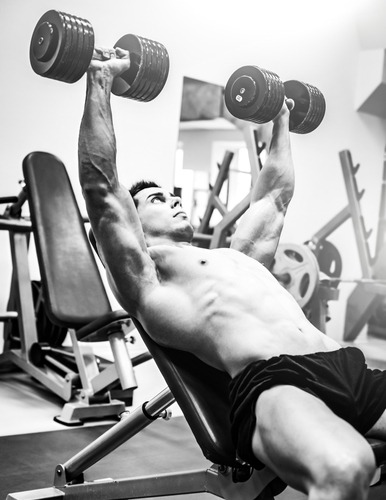
Dumbbell Press (Flat or Slight Incline) Lie on a bench with a dumbbell in each hand, palms facing forward, elbows at roughly 75 degrees from your torso. Press the dumbbells upward until your arms are extended, then slowly lower them back down.
This movement works because the dumbbells move independently, which forces each side of your chest to do its own work. You also get a deeper stretch at the bottom than with a barbell, which means greater muscle fiber recruitment.
Cable Flyes (Low, Mid, or High Cable) Stand between two cable stations and pull the handles together in a wide, sweeping arc in front of your chest. The cable keeps constant tension on the muscle throughout the entire movement, unlike free weights, where tension drops at the top. This makes cable flyes exceptional for teaching you how to feel your chest during exercise, which is one of the most valuable skills a beginner can build.
Resistance Bands Press or Fly Anchor resistance bands behind you and press or fly them forward, mirroring a cable movement. Resistance bands are incredibly accessible — you can use them at home, at a hotel, or between gym sessions.
They add what is called “accommodating resistance,” meaning the band gets harder to push as you reach full extension, which challenges your chest even more at peak contraction.
Incline Push-Ups Place your hands on a bench or elevated surface and perform a push-up. This beginner-friendly variation reduces the amount of bodyweight you press, making it more manageable while still training the chest, triceps, and front shoulders. It is also a great warm-up movement.
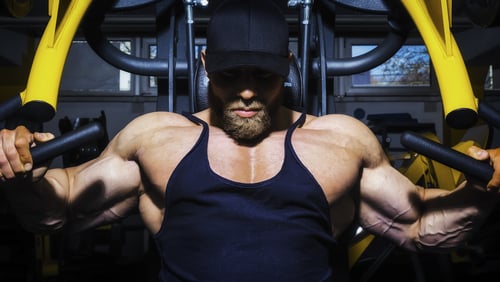
Machine Converging Press Sit at a chest press machine where the handles move inward as you press. This converging motion mimics how the chest muscles actually function — they pull the arms across the body.
Machines are ideal for beginners because they guide the movement path and remove the balance demand of free weights, letting you focus entirely on contracting the chest.
The Science Behind Chest Growth: Stretch, Contract, Repeat
To understand why this combination of exercises works so well, you need a basic understanding of how muscles grow. Muscle growth — also called hypertrophy — occurs when muscle fibers experience sufficient mechanical tension and damage during training, prompting the body to rebuild them slightly thicker and stronger. Two key factors drive this process: lengthening under load (the stretch) and peak contraction (the squeeze).
Movements like the dumbbell press and cable flyes place the chest muscle in a stretched position while it is still under load. Research consistently shows that training a muscle through a full range of motion, especially in the lengthened position, produces greater hypertrophy than partial-range movements. This is one reason a deep dumbbell press is so effective — your chest is doing real work even at the bottom of the rep.
On the other hand, movements like the machine-based convergent press and resistance-band press prioritize peak contraction. When the handles come together at the end of the press, your inner chest fibers — the sternal head of the pectoralis major — are working hardest.
Training this peak squeeze ensures balanced chest development across the muscle’s full width. Combining stretch-focused and contraction-focused movements is the strategic foundation of this plan, and it is why you will feel this program working from the very first session.
Your 6-Month Chest Transformation Plan for Beginners
This 6-month chest transformation plan for beginners is structured in three two-month phases. Each phase builds on the previous one in terms of volume, frequency, and complexity. The optimal frequency for chest training for beginners starts at twice per week and gradually increases to three times per week as recovery improves and skill develops.
Phase 1 — Months 1 and 2: Building Your Foundation (2x Per Week)
The goal in Phase 1 is not to go heavy. The goal is to establish proper technique, strengthen the connective tissue around the shoulder joint, and start building the mind-muscle connection that will make every future workout more effective.
Phase 1 Workout A (Repeat twice per week with at least 48 hours between sessions)
Incline Push-Ups — 3 sets of 10–15 reps | Rest: 60 seconds
Dumbbell Flat Press — 3 sets of 10–12 reps | Rest: 90 seconds (start with 5–8 kg / 10–15 lbs)
Machine Converging Press — 3 sets of 12 reps | Rest: 90 seconds
Cable Fly (Mid Cable) — 3 sets of 12–15 reps | Rest: 60 seconds
Focus on slow, controlled reps. Use a 2-second lowering phase on every rep. Do not rush. By the end of month 2, you should be able to add 2–3 kg (5 lbs) to your dumbbell press while maintaining clean form.
Phase 2 — Months 3 and 4: Adding Volume (2–3x Per Week)
In Phase 2, training frequency increases slightly, and total volume goes up. Your muscles are now conditioned enough to handle more work, and your technique has improved to the point where you can benefit from it. This is where real muscle-building momentum begins.
Phase 2 Workout A
Incline Push-Ups — 2 sets of 15 reps | Rest: 45 seconds (warm-up)
Dumbbell Incline Press — 4 sets of 10–12 reps | Rest: 90 seconds
Machine Converging Press — 3 sets of 12–15 reps | Rest: 90 seconds
Cable Fly (Low Cable) — 3 sets of 12–15 reps | Rest: 60 seconds
Resistance Band Press — 2 sets of 15 reps | Rest: 60 seconds
Phase 2 Workout B (Add this third session mid-month 3 if recovery is good)
Flat Dumbbell Press — 4 sets of 8–10 reps | Rest: 2 minutes
Cable Fly (High Cable) — 3 sets of 15 reps | Rest: 60 seconds
Machine Converging Press — 3 sets of 12 reps | Rest: 90 seconds
Resistance Band Fly — 2 sets of 15 reps | Rest: 60 seconds
By the end of month 4, you should be pressing noticeably heavier dumbbells than when you started, and your chest should feel more active and engaged during every exercise.
Phase 3 — Months 5 and 6: Intensity and Variety (3x Per Week)
Phase 3 introduces slightly greater intensity through heavier loading and extended-technique methods. Three sessions per week are now the standard, and small weight gains occur week to week. This phase is where the visual results of building a bigger chest really start to show.
Phase 3 Workout A
Dumbbell Flat Press — 4 sets of 8 reps (heavier than Phase 2) | Rest: 2 minutes
Cable Fly (Mid Cable) — 4 sets of 12 reps | Rest: 90 seconds
Machine Converging Press — 3 sets of 10 reps (heavier) | Rest: 2 minutes
Incline Push-Ups — 2 sets to near failure | Rest: 60 seconds
Phase 3 Workout B
Dumbbell Incline Press — 4 sets of 8–10 reps | Rest: 2 minutes
Cable Fly (Low Cable) — 3 sets of 15 reps | Rest: 90 seconds
Resistance Band Press — 3 sets of 15–20 reps | Rest: 60 seconds
Machine Converging Press — 3 sets of 12 reps | Rest: 90 seconds
Phase 3 Workout C
Flat Dumbbell Press — 4 sets of 6–8 reps (challenging weight) | Rest: 2 minutes
Cable Fly (High Cable) — 3 sets of 12 reps | Rest: 90 seconds
Resistance Band Fly — 3 sets of 15 reps | Rest: 60 seconds
Machine Converging Press — 2 sets of 15 reps (lighter, focus on squeeze) | Rest: 90 seconds
The Mistakes That Quietly Kill Your Progress
Even with a great program, certain habits will slow everything down. Avoiding these mistakes is just as important as following the plan itself.
Ego lifting — Choosing a weight that is too heavy forces other muscles to compensate. Your shoulders and triceps take over, and your chest barely works. Always prioritize form over load.
Neglecting the full range of motion — Partial reps feel harder because you are moving more weight, but they shortchange the most important part of the movement. Lower the dumbbells all the way down. Let your chest stretch.
Ignoring the mind-muscle connection — the ability to consciously feel your chest during exercise. It sounds simple, but it takes practice. Before each set, squeeze your chest deliberately. Think about using your chest to push, not your hands.
Skipping the warm-up — Cold muscles do not perform well. Spend 5–10 minutes on incline push-ups, light band work, and shoulder circles before your working sets.
How to Feel Your Chest During Exercise (And Why It Matters)
One of the most underrated skills in beginner training is learning how to feel your chest during exercise — not just going through the motions. This concept is called the mind-muscle connection, and research supports it as a real, trainable skill that improves muscle activation.
To build this connection, try this: before you start a set, place one hand on your chest and squeeze it deliberately, as if you were trying to flatten it. Feel the muscle tighten. Now hold that intention in your mind as you perform the exercise.
Think “chest is pushing,” not “hands are pushing.” It sounds like a small mental shift, but over time, it significantly increases the amount of muscle that actually fires during each rep. This one habit can make a beginner’s workout as effective as an intermediate lifter’s.
Recovery Nutrition, Protein Intake, Sleep, and Consistency: The Pillars Outside the Gym
Training hard is only half the equation. The other half happens away from the gym, and most beginners underestimate how important it is. Recovery nutrition, protein intake, sleep, and consistency are not optional extras — they are the foundation that makes everything else work.
Protein intake is the most critical nutritional factor for muscle growth. Aim for 1.6 to 2.2 grams of protein per kilogram of bodyweight per day. For a 70 kg (154 lb) person, that is 112-154 grams of protein daily. Spread it across meals — your body uses it more efficiently in doses of 30–40 grams at a time. Good sources include chicken, fish, eggs, Greek yogurt, cottage cheese, and plant-based options like lentils and tofu.
Sleep is when your body actually rebuilds the muscle you broke down in training. Growth hormone peaks during deep sleep, and protein synthesis — the process of building new muscle tissue — is most active during rest. Aim for 7–9 hours per night. Poor sleep is one of the fastest ways to halt progress, no matter how well you train.
Consistency beats perfection every single time. Missing one workout will not derail your progress. Missing three weeks in a row will. The best program in the world only works when it is actually followed. Show up, do the work, rest, repeat.
FAQ: What to Do When Progress Stalls
What if my chest stops growing after a few weeks? This is called a plateau, and it is completely normal. The most common cause is that your body has adapted to the current training stimulus. Add one more set per exercise, increase the weight by 2 kg (5 lbs), or slow your rep tempo down. Any change in stimulus can restart progress.
Why is my chest sore on both sides, but in different amounts? Muscle imbalances are extremely common. One side of your body is almost always slightly stronger. Dumbbell exercises help correct this over time because each arm works independently. Do not adjust the weight mid-set — let the program naturally even things out over several months.
I have been training for two months, but I do not see any visible changes yet. Is something wrong? Not at all. The first two months of training are largely neurological — your nervous system is learning to coordinate the movements more efficiently. Visible size changes typically begin between months 2 and 4. Stay the course.
How much soreness is normal? Some soreness 24–48 hours after training — called DOMS (delayed onset muscle soreness) — is normal, especially in the early weeks. Severe soreness that limits your range of motion or lasts more than 4 days suggests you may have done too much too soon. Scale back slightly and progress more gradually.
Conclusion: Keep It Simple, Keep Showing Up
Building a bigger chest does not require a barbell, a spotter, or a complicated program. It requires the right exercises, a clear plan, and the discipline to follow through consistently over six months. This 6-month chest transformation plan for beginners gives you exactly that — a progressive, science-backed roadmap from your very first workout to a noticeably stronger, fuller chest.
Trust the process. Add weight gradually. Prioritize form. Eat enough protein. Sleep well. And above all, keep showing up. Results do not come from a single great workout — they come from hundreds of average workouts done consistently over time. Start where you are, use what you have, and commit to the plan. Your chest will thank you for it.
If you have questions about the plan, the progress you have made, or anything else related to chest training, drop them in the comments below. This space exists to help you grow — in every sense of the word.