Visit Innatefit1.com for exercise wear and equipment!!!

12 Underrated Bicep Exercises That Build Bigger Arms Faster
Discover 12 underrated bicep exercises for bigger arms, including incline dumbbells, towel chin-ups, and Bayesian cable curls. Advanced hypertrophy training for intermediate to advanced lifters seeking growth beyond standard curls.
SELF-HELPBEGINNERS FITNESS TIPSWORKOUTSFITNESS TIPSHYPERTROPHYSTRENGTH TRAININGMOTIVATION
Joseph Battle
6/29/202616 min read


Introduction: Why Standard Curls Are Leaving Gains on the Table
You have been doing barbell curls and dumbbell curls for years. Your form is solid. Your progression has been consistent. Yet, your biceps have plateaued. The pump feels familiar. The growth has stalled. This is the reality for most intermediate and advanced lifters who rely exclusively on mainstream exercises—they’re efficient, but they are not complete builders of the biceps.
The biceps are a relatively simple muscle group anatomically, but they respond dramatically when exposed to novel stimuli. The reality is that standard curls, while foundational, only scratch the surface of what your biceps can achieve. They operate within a limited range of motion and a mechanical tension profile. Your arms aren’t growing because your muscles have adapted to the same angles, the same speeds, and the same demand patterns you’ve been using for months.
This article introduces the 12 best underrated exercises for bigger biceps that operate outside the conventional training box. These movements target the biceps through unique angles, altered leverage points, and mechanical advantages that force your muscle fibers to work harder and adapt faster.
More importantly, they break the monotony that leads to plateaus. Whether you’re looking to add thickness to the belly of the muscle, improve peak height, or build a more complete arm, these exercises deliver results when programmed strategically.
The following movements are not gimmicks or novelties designed to impress people at the gym. They’re scientifically sound, battle-tested by strength coaches and competitive bodybuilders, and specifically chosen for intermediate to advanced lifters who already understand basic training principles. Over the next 6 to 8 weeks, implementing these exercises will fundamentally change how your biceps respond to training.
Incline Dumbbell Curl – The Stretch Specialist
Why it’s underrated: Most lifters skip incline work for biceps, yet this position creates extraordinary stretch tension on the long head of the biceps. The mechanical disadvantage at the bottom position forces your muscle fibers to work harder throughout the entire range of motion.
How to perform it: Set an adjustable bench to a 45-degree incline and position yourself so your back and head are supported. Hold a dumbbell in each hand with your arms hanging directly downward.
The key here is allowing your elbows to drift slightly backward as you curl the weights upward, maintaining a neutral wrist position. Squeeze at the top, then control the descent over 2 to 3 seconds, feeling the stretch at the bottom position before initiating the next rep.
Key muscle activation tips: The incline position removes almost all momentum, making cheating nearly impossible. Focus on initiating the curl from your biceps, not your shoulders. Your elbows should remain relatively fixed throughout the movement.
Many lifters make the mistake of bringing their elbows too far forward, which reduces the stretch stimulus. Keep them back, and you should feel a profound difference in muscle activation. The stretched position forces the long head of the biceps to work overtime, creating the mechanical tension necessary for hypertrophy.
Sets and reps recommendation: Execute 3 sets of 8 to 12 reps using moderate weight. You’re not going heavy here—control and the stretch sensation matter more than absolute load. Use a tempo of 2 seconds up, 1 second pause, and 3 seconds down to maximize time under tension.
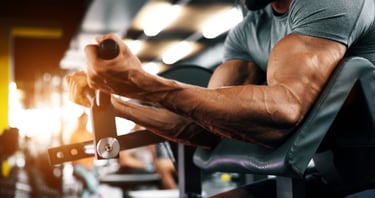
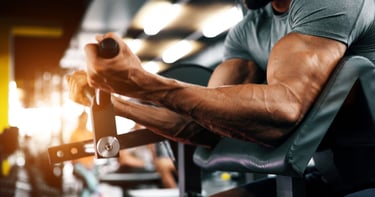
Machine Preacher Curl – Constant Tension Redefined
Why it’s underrated: Machine preacher curls lock your elbows into a fixed position, eliminating all momentum and forcing constant tension throughout the rep. This relentless pressure builds muscle tissue faster than free-weight alternatives because your biceps never get a break.
How to perform it: Sit at a preacher curl machine with your chest pressed against the pad. Adjust the seat height so your elbows rest comfortably at the apex of the curved pad. Your upper arms should be nearly vertical. Grasp the handles with a shoulder-width grip and begin curling. The machine prevents your elbows from moving backward, so the biceps must do all the work.
Key muscle activation tips: This is one of the best constant tension cable exercises adapted for machine work. Never fully extend your elbows at the bottom position—maintain a slight bend to keep tension on the biceps.
The machine eliminates your ability to “cheat,” which some lifters see as limiting, but which actually guarantees maximum muscle recruitment. Slow down the eccentric (lowering) phase to 2 to 3 seconds, resisting the urge to let gravity do the work. This eccentric emphasis drives growth.
Sets and reps recommendation: Perform 3 to 4 sets of 10 to 15 reps. The higher rep range works well here because the constant tension and machine stability allow safe execution without joint stress. Rest 60 to 90 seconds between sets.
Towel Chin-Up – Grip Mastery Meets Bicep Demand
Why it’s underrated: Towel chin-ups dramatically increase grip diameter and demand, forcing your biceps to work harder to overcome the mechanical disadvantage. This variation is rarely programmed but delivers exceptional thickness and strength development.
How to perform it: Drape two hand towels over a pull-up bar, spacing them about shoulder-width apart. Grip the towels with your palms facing you (chin-up position). Pull yourself upward, driving your elbows downward and backward. Your goal is to get your chin above the towels. Control the descent over 2 to 3 seconds before repeating.
Key muscle activation tips: The thicker grip of the towel reduces momentum and places your biceps at a mechanical disadvantage, triggering greater muscle recruitment. Your forearms will fatigue, but your biceps will be the primary driver.
Many lifters make the mistake of trying to perform excessive volume here—this exercise is demanding, so quality matters more than quantity. If strict towel chin-ups are too challenging, use a resistance band looped under your feet for assistance. Your target is smooth, controlled reps where you feel the biceps working throughout.
Sets and reps recommendation: Complete 3 sets of 5 to 10 reps, depending on your current strength level. Rest 2-3 minutes between sets, as this is a heavy, demanding movement. If bodyweight is too challenging, use band assistance to maintain 5-10 reps per set.
Drag Curl – Anterior Shoulder Relief with Bicep Emphasis
Why it’s underrated: Drag curls shift the shoulder joint into a position that minimizes involvement while maximizing bicep isolation. This movement places the biceps in a stronger mechanical position, allowing heavier weights while reducing anterior shoulder stress.
How to perform it: Stand with a barbell at hip height using a shoulder-width, underhand grip. Rather than curling in a traditional arc, drag the bar upward along your body, keeping your elbows as close to your torso as possible. Your elbows stay fixed throughout—only your forearms move. Curl the bar to chest height, then lower it with control back to the starting position.
Key muscle activation tips: The defining characteristic of the drag curl is the bar’s vertical path. Keep the bar in contact with your body throughout the entire movement. This close-to-body positioning places tremendous stress on the biceps while removing stress from the anterior deltoids.
Your forearms will feel fatigued, but the biceps should be doing the majority of the work. A common mistake is allowing the bar to swing away from your body, which converts this into a traditional curl and defeats the purpose. Stay tight, and stay close.
Sets and reps recommendation: Perform 3 sets of 8 to 12 reps using moderate to moderately heavy weight. You can typically handle more load on drag curls compared to traditional curls because of the improved mechanical leverage. Rest 90 to 120 seconds between sets.
Bayesian Cable Curl – Advanced Angle Innovation for Constant Tension
Why it’s underrated: Bayesian cable curls are rarely programmed despite delivering superior constant tension cable exercises compared to standard straight-bar cable curls. The angle of pull, combined with cable resistance, creates a unique resistance curve that builds muscle mass exceptionally fast.
How to perform it: Set the cable machine to chest height and attach a single-arm handle to one side. Stand perpendicular to the machine, roughly arm’s length away. Grasp the handle with your arm extended, and curl the handle diagonally across your body toward your opposite shoulder. The key is the angle: pull straight up, not across your body at roughly 45 degrees.
Key muscle activation tips: The Bayesian cable curl creates accommodating resistance, meaning the load increases as you progress through the range of motion. This matches your strength curve perfectly, allowing maximum force production at the top where you feel the strongest.
Never fully extend your arm at the starting position—maintain a slight bend to keep tension constant on the biceps. The diagonal path of motion means you’re hitting the biceps from an angle that standard curls miss, which drives adaptation and growth. Control both the positive and negative phases of the movement, resisting the cable’s pull on the way down.
Sets and reps recommendation: Execute 3 to 4 sets of 10 to 12 reps per arm. The constant tension provided by the cable means you do not need a heavy weight to generate stimulus. Focus on the mind-muscle connection and controlled movement patterns. Rest 60 to 90 seconds between sets.
Zottman Curl – Supination Transition for Complete Development
Why it’s underrated: The Zottman curl integrates supination and pronation within a single rep, working the biceps concentrically while the brachioradialis and forearms work during the eccentric phase. This comprehensive muscle recruitment accelerates overall arm development.
How to perform it: Hold a pair of dumbbells at your sides with a supinated grip (palms facing forward). Curl the dumbbells upward in a traditional dumbbell curl pattern. At the top position, rotate your hands so your palms face downward. Lower the dumbbells with this pronated grip, controlling the descent over 2 to 3 seconds. At the bottom, rotate back to supination and repeat.
Key muscle activation tips: The grip rotation at the top of the movement is crucial. This transition shifts mechanical tension from the biceps to the forearm and the brachioradialis during the eccentric phase. This variation ensures complete arm development rather than bicep-only growth.
Many lifters skip the pronation variation, focusing only on the supinated curl, but the pronated eccentric is where the magic happens. Your forearms will fatigue quickly, but your biceps will receive stimulus throughout the movement.
Sets and reps recommendation: Complete 3 sets of 10 to 12 reps using moderate weight. The grip transition and pronated eccentric make this exercise more technically demanding than standard curls, so lighter weight with perfect execution beats heavier weight with sloppy form. Rest 75 to 90 seconds between sets.
Spider Curl – Isolation Without Compromise
Why it’s underrated: Spider curls are typically performed on preacher benches but rarely programmed despite providing unparalleled bicep isolation. The position eliminates momentum entirely and prevents shoulder involvement, ensuring pure biceps activation.
How to perform it: Straddle a preacher bench backward, draping your chest over the pad with your underarms resting on the bench itself. Your arms hang downward over the curved pad, feet planted firmly on the ground for stability. Curl dumbbells upward using only your forearms, keeping your upper arms stationary throughout. Lower the dumbbells with control before repeating.
Key muscle activation tips: The spider curl is an isolation movement, meaning your biceps do almost all the work. You cannot use momentum or body English here—your muscles must generate all the force. This absolute isolation drives growth rapidly. A common mistake is allowing your upper arms to move or your elbows to flare outward.
Maintain complete upper arm stability. Feel the biceps work through the entire range of motion, from the stretched bottom position to the squeezed top position. Because isolation is so complete, you will feel the pump intensely—this is normal and indicates proper execution.
Sets and reps recommendation: Perform 3 to 4 sets of 10 to 15 reps using lighter to moderate dumbbells. The isolated nature of this movement means that a heavyweight isn’t necessary to generate a growth stimulus. Focus on consistent tension and controlled tempos. Rest 60 to 75 seconds between sets.
Cross-Body Hammer Curl – Unilateral Focus and Thickness Building
Why it’s underrated: Cross-body hammer curls train each arm individually while emphasizing the brachialis and brachioradialis, muscles that push the biceps outward and create apparent arm thickness when fully developed.
How to perform it: Hold a single dumbbell in one hand at your side using a neutral grip (thumb pointing upward). Curl the dumbbell diagonally across your body toward your opposite shoulder. Control the eccentric phase before returning to the starting position. Complete all reps on one side before switching arms.
Key muscle activation tips: The cross-body path of motion means your biceps work through a longer range of motion compared to traditional hammer curls. The neutral grip shifts emphasis to the brachialis, a muscle that sits beneath the biceps and contributes significantly to arm circumference.
Many lifters ignore the brachialis entirely, focusing only on traditional supinated curls, but this is a missed opportunity for size. The unilateral nature of the cross-body hammer curl also exposes muscular imbalances—most people have a dominant side. Correcting these imbalances improves symmetry and long-term injury prevention.
Sets and reps recommendation: Execute 3 to 4 sets of 10 to 12 reps per arm. Unilateral movements require slightly fewer reps than bilateral movements due to reduced stability and increased demands on the nervous system. Rest 75 to 90 seconds between arms.
Reverse Grip Barbell Curl – EZ-Bar Integration for Wrist Comfort
Why it’s underrated: EZ-bar reverse curls train the brachialis and brachioradialis extensively while providing wrist comfort that a standard straight bar cannot match. The ergonomic grip reduces wrist strain while building impressive arm thickness.
How to perform it: Load an EZ-bar with moderate weight and grasp it with a pronated grip (palms facing downward), hands positioned slightly wider than shoulder width. Stand upright with the bar at hip height. Curl the bar upward toward your shoulders, keeping your elbows stationary throughout. Lower the bar with control before repeating.
Key muscle activation tips: The pronated grip shifts the primary responsibility from the biceps to the brachialis and forearms. However, the biceps still receive significant stimulus, making this exercise valuable for complete arm development. The EZ-bar’s angled grip is significantly more comfortable than a straight barbell, reducing wrist strain and allowing higher volume without joint pain.
Your forearms will fatigue before your biceps, but this is expected. Never bounce at the bottom or use momentum—control is paramount. The brachialis muscle sits beneath the biceps and contributes substantially to overall arm circumference, making reverse curls a cornerstone exercise for arm growth.
Sets and reps recommendation: Perform 3 to 4 sets of 8 to 12 reps using moderate weight. The EZ-bar allows comfortable loading without wrist discomfort. Rest 90 to 120 seconds between sets because this movement demands significant nervous system activation.
Concentration Curl with Supinated Grip and Slow Tempo – The Finisher
Why it’s underrated: Standard concentration curls are common, but adding supination and extending the tempo transforms this finishing movement into an exceptionally demanding, growth-promoting exercise that most lifters overlook.
How to perform it: Sit on a flat bench with your feet firmly planted on the ground, knees bent at roughly 90 degrees. Hold a single dumbbell in one hand and rest your elbow against your inner thigh. Rather than using a neutral hammer grip, use a supinated grip where your palm faces your body. Curl the dumbbell upward, then lower it over a 3 to 4 second eccentric phase. Complete all reps before switching arms.
Key muscle activation tips: A supinated grip in a seated position maximizes biceps isolation. Your elbow is braced against your thigh, which completely eliminates momentum. The extended eccentric phase—3 to 4 seconds of lowering—creates tremendous mechanical tension and metabolic stress, two of the primary drivers of muscle growth.
Most lifters rush the eccentric phase, missing the opportunity for growth. Slow down, control the weight, and feel the biceps working. This variation creates an intense pump and muscle soreness, indicating proper stimulus.
Sets and reps recommendation: Complete 3 sets of 10 to 15 reps per arm using light to moderate dumbbells. The slow eccentric phase means you should not need heavy weights to generate growth stimulus. This movement is excellent as a finisher at the end of arm day. Rest 60 to 75 seconds between arms.
Cable Overhead Curl – Stretch Position Emphasis
Why it’s underrated: Overhead curls eliminate momentum and force the biceps into a stretched position throughout the movement. The constant tension and stretch combination drives rapid growth that most lifters never experience.
How to perform it: Set the cable machine to its highest position, then stand facing away from the machine. Grasp the handle with a single arm, your arm extended upward and slightly behind your head. Curl your forearm toward your head, maintaining a strong core and stable torso. The cable should be pulling your arm backward and upward throughout the movement.
Key muscle activation tips: The overhead position creates a relentless stretch on the biceps. Your muscle fibers are lengthened throughout the movement, which is optimal for growth stimulus. Never allow your lower back to arch excessively—maintain core stability throughout. Your upper arm should remain nearly vertical.
A common mistake is allowing the cable to pull your elbow forward, which reduces the stretch and bicep activation. Keep your elbow positioned behind your body, resisting the cable’s pull. This movement builds biceps peak height by emphasizing the short head of the biceps.
Sets and reps recommendation: Execute 3 to 4 sets of 10 to 15 reps per arm. The stretch position and constant tension mean moderate weight is sufficient. Focus on consistent tension throughout each rep. Rest 60 to 90 seconds between arms.
Decline Dumbbell Curl – The Eccentric Specialist
Why it’s underrated: Decline curls are rarely programmed despite creating an extended range of motion that stretches the biceps significantly. This expanded range, combined with dumbbells, creates an exceptional stimulus for growth.
How to perform it: Set a bench to a 30-to-45-degree decline position. Sit on the bench and allow your arms to hang naturally with dumbbells in each hand, palms facing forward. Curl the dumbbells upward, then lower them under control over 2 to 3 seconds, allowing the dumbbells to drop slightly below hip level before initiating the next rep.
Key muscle activation tips: The decline position removes stability, requiring your core and stabilizer muscles to work continuously. This creates a secondary stimulus that enhances overall hypertrophy. The extended range of motion means your biceps are stretched more than in upright curls.
Never swing the dumbbells or use momentum—control is essential. Many lifters make the mistake of not allowing sufficient range of motion, curling from waist to shoulder rather than utilizing the extended range that the decline position provides. Lower the dumbbells, extend the stretch, and grow.
Sets and reps recommendation: Complete 3 sets of 8 to 12 reps using moderate dumbbells. The decline position and extended range mean you will be handling slightly less weight than in upright curls—this is normal and expected. Rest 90 to 120 seconds between sets.
Building Your Advanced Arm Training Routine: Integration and Programming Strategy
Now that you understand all 12 exercises, the critical question becomes: how do you integrate these movements into an effective training program? Simply performing all 12 exercises in a single session would be counterproductive, leading to overtraining and diminishing returns. Strategic selection, intelligent programming, and progressive overload are what separate lifters who experience consistent growth from those who plateau indefinitely.
For intermediate- to advanced-level lifters training biceps twice per week, select 3 to 4 movements per session based on movement-pattern variety and mechanical tension. An effective approach is alternating between a “heavy” day emphasizing mechanical tension and lower reps, and a “volume” day emphasizing hypertrophic rep ranges and pump. Here’s a sample framework:
Arm Day One (Heavy Emphasis): Begin with incline dumbbell curls for 3 sets of 8 to 10 reps, immediately followed by drag curls for 3 sets of 8 to 12 reps. These movements demand significant load and create mechanical tension. Finish with machine preacher curls for 3 sets of 10-12 reps to build volume while maintaining intensity. This session prioritizes heavy loading and nervous system demand.
Arm Day Two (Volume Emphasis): Start with cable overhead curls for 3 sets of 12-15 reps to establish the mind-muscle connection early, when fatigue is minimal. Progress to Bayesian cable curls for 3 to 4 sets of 10 to 12 reps, emphasizing the constant tension stimulus. Conclude with concentration curls for 3 sets of 12-15 reps, finishing the session with isolated, controlled work. This session emphasizes metabolic stress and the muscular pump.
Alternative pairings exist based on individual preferences. Some lifters prefer heavier, lower-rep work and should emphasize towel chin-ups, reverse grip barbell curls, and drag curls. Others respond better to higher-rep, constant-tension work and should prioritize cable overhead curls, Bayesian cable curls, and spider curls. Experimentation and self-assessment determine the optimal approach for your physiology.
Progressive overload remains non-negotiable. Adding reps, increasing load, decreasing rest periods, or extending time under tension all constitute valid progression strategies. Track your performance metrics week to week. If you completed 10 reps at 30 pounds last week, shoot for 11 reps this week, or 10 reps at 32 pounds. Small incremental improvements compound into significant growth over months.
Avoid the common mistake of performing excessive volume. Most advanced hypertrophy exercises produce sufficient stimulus at 9 to 12 total sets per session. Adding more volume doesn’t accelerate growth; it delays recovery and diminishes the quality of each set. Keep sessions efficient, intense, and focused.
Avoiding Overtraining While Maximizing Growth: Recovery and Sustainability
Advanced arm training routines demand intelligent recovery strategies. Training biceps twice weekly with high-volume, high-intensity sessions accumulates significant fatigue. Without adequate recovery, your nervous system will become depleted, cortisol levels will rise, and growth will stall or reverse.
Prioritize sleep above all other recovery modalities. Eight to nine hours nightly is non-negotiable for advanced lifters. Sleep is when growth hormone peaks, when protein synthesis is highest, and when your nervous system recovers. Sacrificing sleep for additional training is a false economy.
Manage overall training volume across your entire program. If you’re training arms twice weekly with significant volume, reduce volume in other muscle groups. A common mistake is performing heavy chest, back, and arm work in the same week. Indirect arm volume accumulates quickly, as pressing movements heavily stress the triceps and pulling movements stress the biceps. Account for this accumulated volume when programming isolated arm work.
Nutrition becomes increasingly important as training intensity increases. Aim for 0.7 to 1 gram of protein per pound of body weight daily. Carbohydrates should be timed around training sessions to maximize performance and recovery. Adequate micronutrition, hydration, and electrolyte balance support recovery processes.
Finally, practice deload weeks. Every 4 to 6 weeks, reduce training volume by 40 to 50 percent. Maintain intensity and movement quality but reduce sets and reps across the board. Deload weeks allow your nervous system to recover fully, reduce joint stress, and prevent overtraining syndrome. Many lifters view deloads as wasted weeks, but they are actually crucial for long-term progress and injury prevention.
Conclusion: Embracing Variety for Continuous Growth
Your biceps have grown accustomed to your current training approach. Standard barbell curls and dumbbell curls have created adaptation, which initially drove growth but has now plateaued. The solution isn’t more of the same—it’s systematic variation through novel stimulus.
These 12 best underrated exercises for bigger biceps operate through different mechanical advantages, altered angles, and unique resistance profiles. They target the biceps from directions your current programming ignores. Incline dumbbell curls create stretch. Machine preacher curls generate constant tension. Towel chin-ups demand grip strength. Drag curls emphasize isolation. Bayesian cable curls provide accommodating resistance. Each movement contributes a unique stimulus.
Over the next 6 to 8 weeks, commit fully to integrating these exercises into your training. Select 3-4 movements per session based on movement quality and mechanical variation. Progress each movement systematically. Track your performance. Adjust based on results. Most lifters experience significant arm growth within 8 weeks of strategically implementing these movements.
Your hypertrophy exercises must evolve as you progress. Advanced arm training routines require advanced movements. The exercises that built your initial gains will not build your final gains. Embrace variety. Challenge your muscles through novel stimuli. Prioritize recovery. Stay consistent. The growth you desire is achievable through intelligent programming and systematic execution.